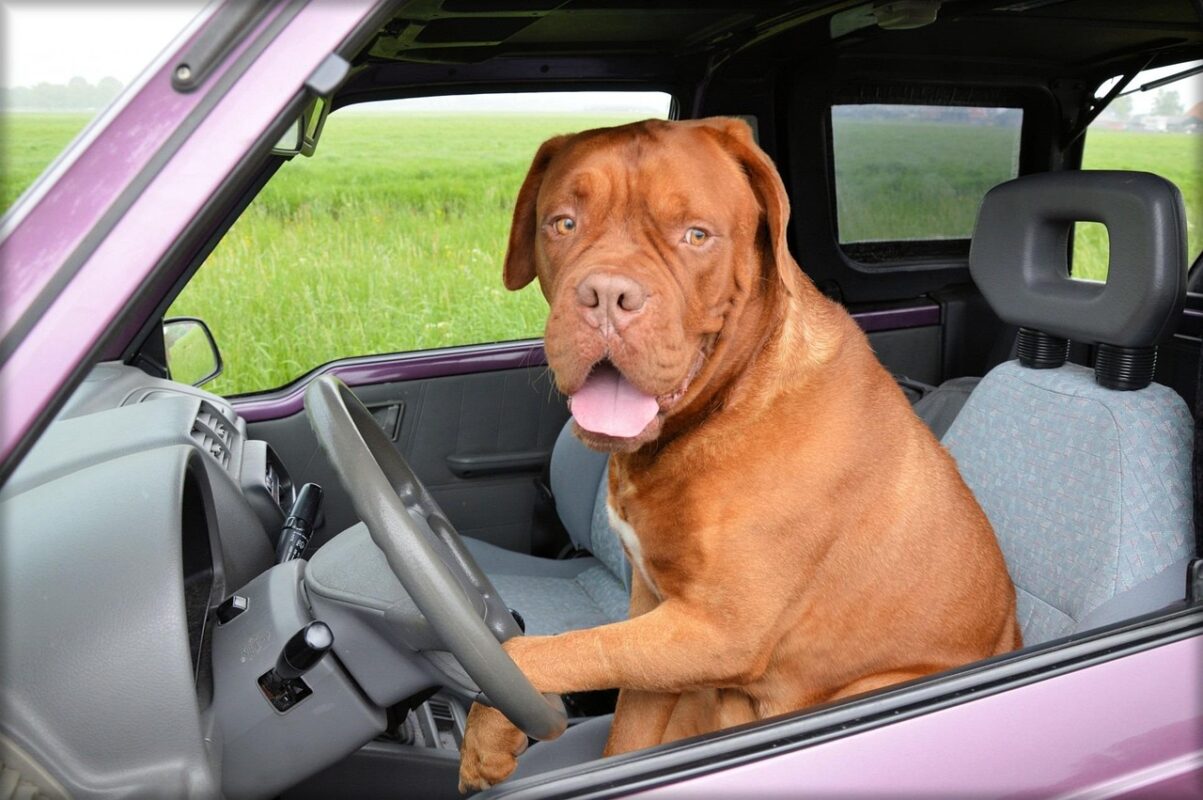
An animal that panics in a car is usually not afraid of the car. It is afraid of what the car has always meant — the vet, the boarding kennel, the move — because those are frequently the only journeys it has ever made. Changing that association takes weeks and is more effective than any product.
Rebuild the association first
Start with the car stationary and the engine off. Let the animal get in, receive something good, and get out again. Repeat over several days until getting in is unremarkable.
Then the engine running but not moving. Then a very short drive that ends somewhere pleasant — a park, a walk, home again. The critical rule is that early journeys must not end at the vet, because a single frightening destination undoes a fortnight of work.
Security is not optional
A loose animal in a car is a hazard to itself and to everyone in the vehicle, and an unrestrained animal in a collision becomes a projectile. The options are a crate or carrier secured in the footwell or boot, a booster seat with a tether, or a harness with a seat-belt attachment.
Two points people miss. A seat-belt tether must attach to a harness, never to a collar — a collar in a sudden stop can cause serious neck injury. And a booster seat is a comfort and containment product rather than a crash restraint unless the manufacturer specifically states a crash rating.
Where in the car
Most animals travel better where they can see a person but are not in direct sun and not next to an active airbag. For dogs, the rear footwell or the back seat with a cover is usually best. For cats, a covered carrier is almost always calmer than an open view.
Facing forward reduces motion sickness for many animals. Facing a side window at high speed increases it.
Motion sickness
Drooling, lip-licking, yawning and swallowing repeatedly are early signs; vomiting is late. Motion sickness is more common in young animals and many grow out of it.
Practical measures: travel on an empty-ish stomach, keep the cabin cool, crack a window for airflow, and take breaks on longer journeys. If it is severe, a vet can prescribe medication that works well, and that is the right route rather than anything from a shop shelf.
Seat covers and what they actually do
A quilted seat cover protects upholstery and gives grip, which matters more than it sounds — an animal sliding on leather at every corner will never settle. Covers with side flaps also stop an animal falling into the footwell.
Note the difference between waterproof and water resistant. We keep whichever word the manufacturer uses rather than upgrading it, because a resistant cover will pass liquid under a determined accident and a waterproof one will not.
Barriers
An extendable grid barrier keeps an animal in the boot area of an estate or SUV. Fit matters: a barrier that is not tensioned properly will be pushed past by a determined dog, and one wedged against trim can damage it.
Measure the opening at the point the barrier will sit, not at its widest, and check the adjustment range on the product page against that number.
Stops on a long journey
- Every two hours for a dog: water, a short walk on a lead, a chance to relieve itself.
- Never leave an animal in a parked car, even briefly. Cabin temperature rises far faster than people expect.
- Attach the lead before opening any door.
- Carry water, a bowl, waste bags and a towel where you can reach them without unpacking.
Cats specifically
A cat travels best in a secure carrier, covered with a light cloth, wedged so it cannot slide. Leaving the carrier out at home as normal furniture for weeks beforehand — with bedding in it, fed in it occasionally — removes most of the fear, because the carrier stops being a signal.
What not to do
Do not let a dog put its head out of a window: eye injuries from debris are common and entirely avoidable. Do not use the boot of a hatchback without a barrier. Do not sedate an animal without veterinary advice.
Carriers, covers, boosters, tethers and barriers are in car and travel, with dimensions and any published weight limits listed on each page.
Practice journeys that go nowhere
The most effective exercise is a five-minute drive that ends back at your own door. It breaks the association between the car and arriving somewhere, and it can be repeated several times a week without any planning.
Build up slowly: five minutes, then ten, then a short drive to a walk. The temptation is to skip ahead once a couple of trips go well, and that is usually where the progress unravels.
What to keep in the car permanently
- A spare lead and a slip lead, kept in the door pocket.
- Water and a folding bowl.
- An old towel for wet or muddy animals.
- Waste bags.
- A copy of vaccination details, useful if a trip ends at an unfamiliar practice.
Everything on that list is small, and having it in the car rather than in the house is what makes it useful on the day something unexpected happens.